
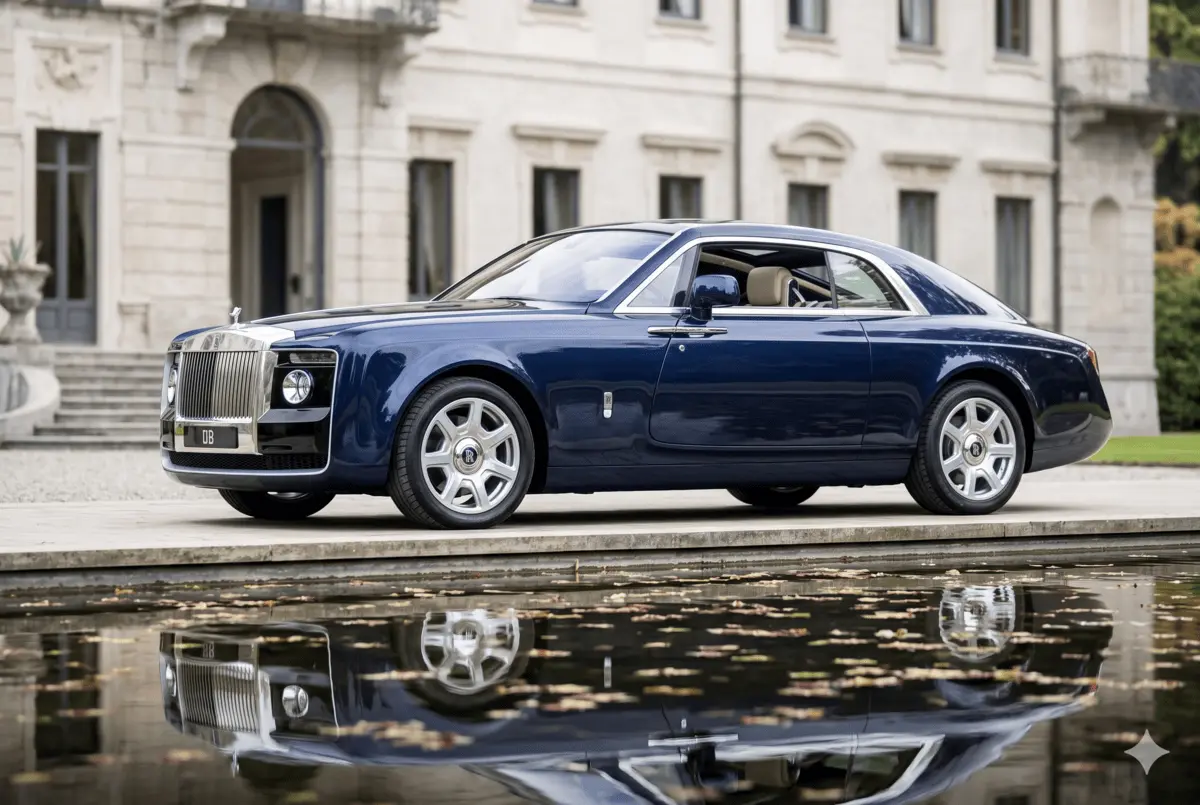
The Rolls-Royce Sweptail price was never printed on any invoice the public has seen, but the figure that stuck is roughly $12.8 million (about £10 million), which the world’s press promptly rounded up to the far more headline-friendly “$13 million”. That made the Sweptail, unveiled on 27 May 2017, the most expensive new car in the world at the time, and the most expensive Rolls-Royce ever built until the Boat Tail, speculated at $28 million, arrived in 2021. Rolls-Royce itself has never confirmed the sum. Its CEO simply called the car “substantially expensive”, which, coming from the head of a company that sells Phantoms, is a rather telling adjective.
And yet the cost of the Sweptail car is the least interesting thing about it. It is a one-off, two-seat coachbuilt coupé that began with a 2013 request from a single customer with a taste for superyachts and private aircraft, who wanted a modern Rolls-Royce with the drama of the swept-tail coachbuilt cars of the 1920s and 1930s. What he got was a glass-roofed, yacht-inspired, champagne-serving piece of rolling haute couture that took roughly four years to finish, and that became the seed for the return of Rolls-Royce Coachbuild.
So in this guide we’ll look at the Rolls-Royce Sweptail cost and why nobody can say it with certainty, who commissioned it, how it was designed, what sits under that long bonnet, why people keep searching for a “McLaren Sweptail”, and where the story stands today.
Rolls-Royce Sweptail at a Glance
| Detail | Fact |
|---|---|
| Car | Rolls-Royce Sweptail, a one-off coachbuilt two-seat coupé |
| Unveiled | 27 May 2017, Concorso d’Eleganza Villa d’Este, Lake Como, Italy |
| Reported price | About US$12.8 million (about £10 million), commonly rounded to $13 million; never officially confirmed |
| Units built | 1 |
| Commissioned | 2013, with roughly four years from request to reveal |
| Design lead | Giles Taylor, then Director of Design |
| Engine (as reported) | 6.75-litre V12, 453 bhp and 531 lb-ft; not published by Rolls-Royce |
| Transmission (as reported) | 8-speed automatic, rear-wheel drive |
| Seats | 2 |
| Built at | Goodwood, West Sussex, England |
| Owner | Not named by Rolls-Royce |
What Is the Rolls-Royce Sweptail?
The Rolls-Royce Sweptail is a one-off coachbuilt coupé, hand-built at Goodwood for one private client and shown to the world at the Concorso d’Eleganza Villa d’Este on Lake Como, Italy, on 27 May 2017. If you have never heard the word “coachbuilt” outside a history book, here is the short version. In the early days of motoring, Rolls-Royce sold you a rolling chassis, meaning the engine, transmission and wheels, and independent coachbuilders such as Park Ward, Gurney Nutting and Jonckheere fitted whatever body you fancied. Rolls-Royce moved to semi-monocoque construction with the Silver Shadow in 1965, and the tradition faded, although the Phantom VI kept a separate chassis until 1993. The Sweptail brought that tradition back, this time entirely in-house.
The name is a description rather than a codename. Swept-tail coachwork was a signature of 1920s and 1930s coachbuilt Rolls-Royces, where the rear of the cabin tapered and swept upwards. On the Sweptail, the roofline rises from the windscreen, overshoots the boot lid, and ends in a raked stern with a “bullet-tip” that houses the centre brake light. Hence, the Sweptail.
It also did not appear out of nowhere. About a year earlier, Rolls-Royce had shown the 103EX Vision Vehicle, a concept that imagined personal luxury mobility where every Rolls-Royce could be “designed in their owners’ image”. The Sweptail was that idea made real, with a real owner and a very real cheque. At the reveal, CEO Torsten Müller-Ötvös called it “a truly magnificent car” and said the company was listening carefully to its most special customers about similar coachbuilt cars. Design chief Giles Taylor was more cautious, telling Autocar that Rolls-Royce would “probably never repeat the level of involvement we had with a customer for this car ever again.” Only one Sweptail exists, and by the sound of it, that is how it will stay.
Rolls-Royce Sweptail Price: How Much Did It Cost?
If you have typed “RR Sweptail price” or “Sweptail Rolls Royce price” into Google, here is what you will find: the commonly quoted Rolls-Royce Sweptail price is about £10 million, or roughly $12.8 million, and it is the reason you see the “Rolls-Royce Sweptail $13 million” headline all over the internet. The number traces back to the Daily Telegraph, which reported in May 2017 that an unnamed buyer had paid £10 million. Rolls-Royce never confirmed it. Müller-Ötvös dismissed the figure as speculation, yet in the same breath described the car as “substantially expensive” and “probably the most expensive new car ever”. GQ noted that the company refused to give a figure, or even a hint of one. So the honest answer to “what is the Rolls-Royce Sweptail cost?” is this: reported, widely repeated, never official.
Rolls-Royce Sweptail Price in Different Currencies
Because the original report was in pounds, every other figure is a conversion. That is why you will see $12.8 million in some places and $13 million in others, and why the same car turns up as “RR Sweptail price” in rupees, euros or any other currency depending on where you search.
| Currency | Reported figure | Note |
|---|---|---|
| US dollars | About $12.8 million | Often rounded up to $13 million in headlines |
| British pounds | About £10 million | The original Telegraph figure, May 2017 |
| Indian rupees | About ₹119 crore | Approximate; moves with the exchange rate |
Why Does the Sweptail Cost So Much?
Rolls-Royce has published no cost breakdown, so what follows is an explanation rather than an invoice. A coachbuilt commission is not a car with a long options list. It is a team of designers, engineers and craftspeople working on one customer’s wishes for the better part of four years, with nothing off the shelf except the mechanical base. The Pantheon grille, the largest on any modern Rolls-Royce, is milled from solid aluminium and hand-polished to a mirror finish. The “08” registration plate was milled from aluminium ingots and hand-polished. The glass roof is described as one of the largest and most complex ever fitted to any car. Even the clock face is made from the thinnest Macassar veneer, a claimed world first, with precision-machined titanium hands. Add bespoke luggage, a hand-built champagne mechanism and a cabin with almost no visible switchgear, and the price starts to feel less like a number and more like a bill for time.
For context, a Bugatti Chiron of the day cost just under $3 million, which means the reported Sweptail price was more than four times that of a Bugatti Chiron.
The Story Behind the Rolls-Royce Sweptail
A Customer With a Very Specific Dream
In 2013, a client walked into the Rolls-Royce world with a request that did not fit any brochure. Rolls-Royce describes him only as one of its most valued customers and a “connoisseur and collector of distinctive, one-off items including super-yachts and private aircraft”. He wanted a two-seat coupé with a large panoramic glass roof, inspired by the coachbuilt Rolls-Royces of the 1920s and 1930s and by yachts. Alex Innes, now Head of Coachbuild Design at Rolls-Royce, has said the client’s ideas came from yachts he owned and spent time on, particularly their sterns. The client, he recalls, described a philosophy rather than handing over a sketch, and the team translated it into a strong, formal, upright front end that tapers towards the rear.
Four Years, Four Classics
Giles Taylor and the Rolls-Royce Bespoke team worked with the customer for roughly four years. Rolls-Royce names four historic cars as the design references, and each one lent the Sweptail something specific:
- 1925 Phantom I Round Door (Jonckheere): the sense of grandeur.
- 1934 Phantom II Streamline Saloon (Park Ward): the tapering glasshouse and rising rear.
- 1934 Phantom II Two Door Light Saloon (Gurney Nutting): the swept-tail coachwork.
- 1934 20/25 Limousine Coupé (Park Ward): the roofline.
Taylor called the result “the automotive equivalent of Haute Couture” and “a Rolls-Royce designed and hand-tailored to fit a specific customer”. Which is a polite way of saying that nobody else gets one.
Who Owns the Rolls-Royce Sweptail?
Nobody outside the company can say for certain, because Rolls-Royce has never named the owner. Some online profiles attribute the car to a Hong Kong-based collector, but that claim traces back to a single secondary source and has never been confirmed, so treat it as unverified. What we do know is that the Sweptail has not been a regular at major auctions, museums or concours since its debut, and its current whereabouts are not publicly confirmed. One detail that is reported is that the car is right-hand drive.
Rolls-Royce Sweptail Design: Exterior, Interior and Hidden Details
The Sweptail looks like nothing else Rolls-Royce has built in the modern era, and that is entirely the point. Where a Phantom is a monument, the Sweptail is a sculpture: long, sleek, and, if we are honest, a little strange in the way that only one-offs are allowed to be.
Exterior
Up front sits a new treatment of the Pantheon grille, the largest of any modern-era Rolls-Royce, milled from solid aluminium, hand-polished to a mirror finish and framed in brushed aluminium. From the windscreen the roofline rises and overshoots the boot lid, helped along by a longer side-window graphic and a wide C-pillar finisher that emphasise length. At the back, a raked stern, the “bullet-tip” housing the centre brake light and a sweeping lower bumper finish the shape, and the bodywork wraps under the car with no visible seams, the way a yacht hull does.
Then there is the glass. The panoramic roof is described by Rolls-Royce as one of the largest and most complex ever fitted to any car, and it is framed by polished aluminium rails that channel towards a vanishing point at the rear of the cabin. Access to the luggage area is through an opening rear backlight, which makes the Sweptail a hatchback of sorts, though nobody at Goodwood will ever use that word. The car has two coach doors hinged at the rear, and the registration number is “08”, with both digits milled from aluminium ingots and hand-polished. Rolls-Royce has not explained the choice.
Interior
The cabin is surprisingly restrained for a car at this price. Polished Macassar Ebony and open-pore Paldao wood run throughout, paired with Light Moccasin and Dark Spice leather on the seats, armrests and dashboard top. Where the rear seats would be, a wooden shelf with an illuminated glass lip takes their place, and above it sits a highly polished hat shelf with inset luggage rails, reached through that opening backlight. A feature called the Passarelle runs from the edge of the windscreen to a teardrop shape, where the name “Sweptail” is debossed on the centre line.
The dashboard is the cleanest Rolls-Royce has produced, with only one control and the rest of the switchgear relocated. The clock face is made from the thinnest Macassar veneer, a claimed world first, with precision-machined titanium hands, and three hand-assembled instrument dials get titanium faces, numbers and hands.
Hidden Compartments and the Champagne Mechanism
This is where the Sweptail becomes a party trick. Two identical panniers are concealed in the outboard walls behind the coach doors, and each deploys forward to present an attaché case. The cases are made of carbon fibre, wrapped in leather matching the interior, with machined aluminium and titanium clasps and locks, and each is sized for a laptop. A full set of bespoke luggage, developed by Rolls-Royce Bespoke, sits in a boot clad in the same wood as the hat shelf.
In the centre console, a one-off hand-built mechanism deploys a bottle of the client’s favourite vintage, from the year of his birth, along with two crystal flutes. Press a button, the chiller lid opens, and the bottle is angled towards the owner. It is, to be fair, the most civilised thing a car has ever done to a cork.
Rolls-Royce Sweptail Specs: Engine, Platform and Performance
Rolls-Royce’s own launch material for the Sweptail said nothing about the engine, gearbox or performance. The figures below are what reputable outlets reported after the reveal, so treat them as reported rather than official. The short version: the Sweptail is a spectacular body wrapped around familiar mechanicals.
| Spec | Reported detail |
|---|---|
| Engine | 6.75-litre V12 |
| Power | 453 bhp (338 kW) |
| Torque | 531 lb-ft (about 720 Nm) |
| Transmission | 8-speed automatic |
| Drive | Rear-wheel drive, right-hand drive |
| Platform | Underpinnings of the previous-generation Phantom family |
| Seats | 2 |
| Top speed and 0-100 km/h | Not published |
| Dimensions and weight | Not published |
On the platform, outlets differ in how they describe it. Some say the Sweptail shares its underpinnings with the Phantom Coupé, others cite the Phantom Drophead Coupé, and one calls it a Phantom saloon underneath. All of them point to the same previous-generation Phantom family. For reference, the Phantom Coupé itself was built from 2008 to 2016 with a 6.75-litre V12 making 453 bhp and 720 Nm, which matches the figures reported for the Sweptail.
Nobody bought this car for lap times. Müller-Ötvös described it as a car that “exudes the romance of travel for its own sake”, and a smooth V12 is exactly the right heart for that. The Sweptail was never meant to chase a Bugatti. It was meant to arrive, gently, and be looked at.
Is the Sweptail the Most Expensive Rolls-Royce?
It was, for a while. At its reveal, the Sweptail was the most expensive Rolls-Royce ever built, and, by the CEO’s own reckoning, probably the most expensive new car ever sold. CNBC added a fair caveat at the time: with one-offs and undisclosed prices, such rankings are contested. The title did not last long. Bugatti’s La Voiture Noire overtook the Sweptail in 2019, and Rolls-Royce then outspent itself twice, first with the Boat Tail and then with the Droptail.
| Car | Unveiled | Reported price | Units |
|---|---|---|---|
| Rolls-Royce La Rose Noire Droptail | August 2023 | About $30 million | 1 (part of a four-car Droptail series) |
| Rolls-Royce Boat Tail | May 2021 | About $28 million (speculated) | 3 |
| Bugatti La Voiture Noire | 2019 | About $18.7 million including taxes (about $12.3 million before) | 1 |
| Rolls-Royce Sweptail | May 2017 | About $12.8 million (reported) | 1 |
So if you are asking about the most expensive Rolls-Royce, the Sweptail is no longer the answer. The Boat Tail and the La Rose Noire Droptail both cost considerably more. If you are asking which one started the conversation, the answer is still the Sweptail.
Is There a McLaren Sweptail?
No. There is no McLaren Sweptail, and McLaren had nothing to do with this car. The Sweptail is a Rolls-Royce, built at Goodwood. The search term most likely comes from the McLaren Speedtail, a very different machine from a very different company. The Speedtail is a hybrid hypercar with 1,035 hp, a top speed of nearly 250 mph, a central driving seat with a passenger on either side, and a production run of 106 cars, priced at £1.75 million (about $2.24 million). Similar-sounding names, opposite philosophies: one was engineered to be as fast as possible, the other to be as admired as possible.
Rolls-Royce Sweptail in 2022 and Since
If you searched for the Rolls-Royce Sweptail 2022, here is the straight answer. The Sweptail was unveiled in 2017, only one was built, and we found no record of a new version, a sale or a public appearance in 2022. What did happen that year is that the story it started kept moving. The second Rolls-Royce Boat Tail made its public debut at Villa d’Este from 20 to 22 May 2022, on the same lake where the Sweptail had been revealed five years earlier. The Droptail followed, with the La Rose Noire presented at Pebble Beach on 18 August 2023.
The Sweptail’s Legacy: How One Car Brought Back Coachbuilding
The Sweptail’s real achievement is not its price. It is what came after. Clients who saw the car wanted their own, and three patrons asked for nautical-inspired bodies on a Rolls-Royce chassis, which became the Boat Tail. In 2021, Rolls-Royce launched Coachbuild as a dedicated department for one-off commissions, and Müller-Ötvös called it “a return to the very roots of our brand”. Back in 2017 he had said the Sweptail was “proof, today, that Rolls-Royce is at the pinnacle of coachbuilding”. It turned out to be a proof of concept as well.