
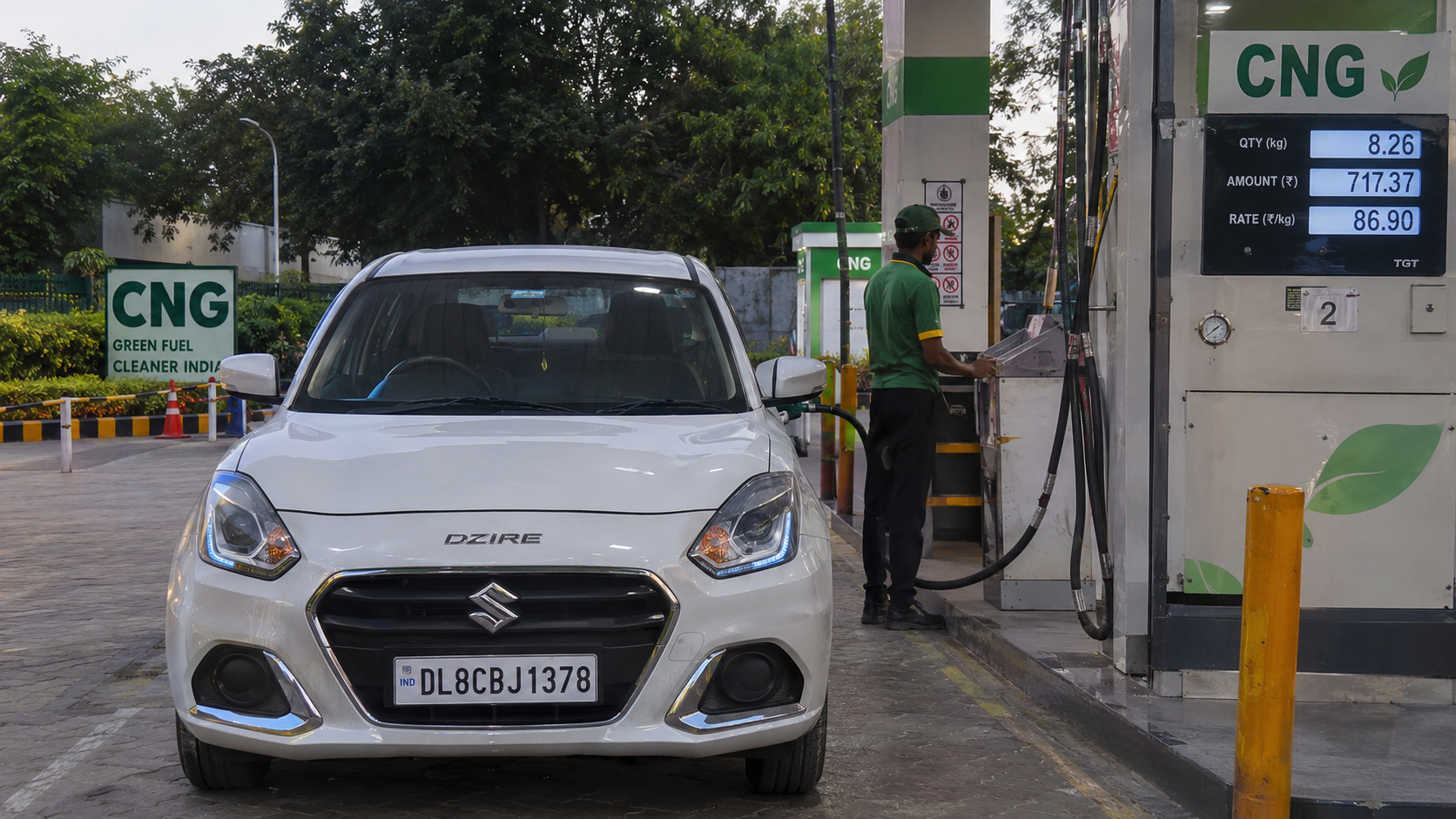
In India, 1 kg of CNG (Compressed Natural Gas) delivers an average of 20 to 28 km in real-world driving, compared to ARAI-certified claims of 24.00 to 36.47 km/kg. Tested Real-World Mileage is highest in 1.0-litre hatchbacks such as the Maruti Celerio (28 km/kg) and lowest in 7-seater MPVs (18 to 19.5 km/kg).
- Entry-level hatchbacks (Alto K10, S-Presso, Celerio, Wagon R) return 25 to 28 km/kg in mixed road tests.
- Compact sedans and premium hatchbacks (Dzire, Swift, Baleno, Aura, Tiago) deliver 22.5 to 26 km/kg.
- Compact SUVs and 7-seater MPVs (Punch, Nexon, Brezza, Victoris, Ertiga, Carens) return 18 to 22.5 km/kg.
While petrol has crossed ₹100 a litre in Delhi, CNG at nearly ₹87 a kg (as of November) still runs a small car for roughly half the per-km cost.
1 Kg CNG Mileage Quick Reference by Car Segment
| Car Segment | ARAI Claimed (km/kg) | Tested City (km/kg) | Tested Highway (km/kg) | Running Cost/Km (@ ₹87/kg) |
| Budget Hatchbacks (Alto K10, Celerio, Wagon R) | 32.73 to 34.43 | 25.0 to 26.5 | 28.5 to 30.0 | ₹3.22 |
| Premium Hatchbacks (Swift, Baleno, Tiago) | 26.49 to 35.34 | 20.5 to 23.5 | 24.5 to 28.0 | ₹3.48 |
| Compact Sedans (Dzire, Aura, Aeris) | 28.00 to 36.47 | 21.0 to 23.5 | 25.0 to 28.0 | ₹3.55 |
| Micro & Compact SUVs (Punch, Nexon, Brezza, Victoris) | 24.00 to 27.02 | 17.5 to 20.5 | 21.5 to 24.5 | ₹4.05 |
| 7-Seater MPVs (Ertiga, XL6, Carens, Triber) | 26.11 to 26.32 | 16.5 to 19.0 | 20.5 to 22.5 | ₹4.46 |
How Many Km Does a Car Run in 1 Kg & a Full 60L Tank of CNG? (Unit Conversion Guide)
A car runs 21 to 27 km on 1 kg of CNG, and 189 to 243 km on 9 kg (a 60-litre fill). CNG is sold by mass, so mileage is measured in km/kg, while “litres” on a brochure means cylinder water capacity.
Why CNG Mileage is Measured in Km/Kg and Not Km/Litre
If you have searched for “1 litre CNG mileage in car” or “CNG car average per litre”, you are in good company. Carmakers quote the CNG cylinder as 55L, 60L or 70L, and that number is water capacity: how much water the empty cylinder would hold. It is a size rating, the same way a suitcase is sold as “60 litres” no matter what you pack inside.
The fuel itself is a gas squeezed to about 200 bar. Its volume swells and shrinks with temperature and compressor pressure, so a litre of gas means very little. Mass doesn’t change with heat. That’s why every CNG dispenser measures what flows into your car with a mass-flow meter and bills you per kg.
So when someone asks for “1 litre CNG mileage”, they almost always mean 1 kg CNG mileage. The two are far apart: a litre of tank volume holds only about 0.15 kg of gas, enough for roughly 3.5 to 4 km.
How Many Kg of CNG Fits in a 55-Litre or 60-Litre Tank?
A 55-litre tank takes 7.5 to 8.5 kg on an actual pump fill, and a 60-litre tank takes 8.3 to 9.2 kg. On paper, natural gas at 200 bar and 15°C weighs about 0.18 kg per litre, which is why some spec sheets rate a 55-litre tank close to 10 kg. Real fills land lower, at 0.14 to 0.155 kg per litre. In simple terms, 1 kg of CNG occupies about 6.5 to 7.2 litres of water volume once it is in your car.
Three things eat into that paper figure:
- Heat of compression: Gas heats up during a fast fill. The dispenser stops at 200 bar, then the gas cools and pressure settles 10 to 15% lower.
- Residual gas: The car switches to petrol before the cylinder is empty, so the 0.5 to 1 kg left behind never shows on your bill or your trip meter.
- Station pressure: Daughter booster stations and long evening queues can stop a fill at 160 to 180 bar.
The practical maths is short. A 60-litre tank divided by 7.2 litres per kg gives 8.3 kg; divided by 6.5 gives 9.2 kg. At 24 km/kg, that is a full-tank range of 200 to 220 km. In peak summer, or at a low-pressure daughter station, knock off another 1 to 1.5 kg.
Tip: To check your own car’s km/kg, fill to the brim, reset the trip meter and drive until the next full fill. Divide the kilometres by the kg printed on the second receipt. One tankful is a rough read; three in a row gives you a number you can trust.
7 Mechanical & Real-World Factors That Drop Your 1 Kg CNG Mileage
Real-world CNG mileage falls 20 to 30% below ARAI claims because of seven factors: short fills at low-pressure dispensers, AC compressor drag (2.5 to 3.5 km/kg in city use), worn spark plugs, a clogged air filter, cold-start petrol burn, 60 to 80 kg of cylinder weight and gearbox calibration.
While the ARAI test runs on a dyno at a fixed temperature with the AC off, your car does none of that.
1. Dispenser Pressure (200 Bar vs 160 Bar) & Morning Fills
Mother and online stations fill to 200 to 220 bar. Daughter booster stations, which get their gas trucked in, often stop at 160 to 180 bar as their storage pressure drops through the day. At 160 bar, a 60-litre tank takes roughly 1.5 kg less. Your km/kg stays the same, but your km per fill doesn’t, and most owners judge mileage by how far a full tank goes.
Temperature works the same way. Cooler gas is denser, so a morning fill packs slightly more kg before the dispenser cuts off. The meter bills by mass, so you are not overcharged either way; you simply get more range per stop.
The fix: fill at a mother or online station in the cooler hours, and always judge mileage by the kg on the receipt, not by the number of fills.
2. AC Compressor Drag on 1.0L to 1.2L Engines
A CNG engine already gives up 10 to 15% of its petrol output. The Swift’s Z12E makes 82 PS on petrol and 70 PS on CNG; the Celerio’s 1.0-litre K10C makes just 56 PS in CNG mode. The AC compressor takes 3 to 5 PS when it runs at full duty. That is close to a tenth of the Celerio’s peak output, and a much larger share of the 10 to 15 PS the car needs to crawl through city traffic.
Which means the engine works harder at every light. In our city road tests, running the AC drops CNG efficiency by 2.5 to 3.5 km/kg. On the highway, where the engine is already loaded, the hit shrinks to about 1 km/kg.
The fix: drive with the windows down for the first minute to flush out hot air, use recirculation, and set 24°C instead of 18°C.
3. High Auto-Ignition Temperature (540°C) & Spark Plug Gap
Natural gas auto-ignites at about 540°C, against roughly 250 to 280°C for petrol. It is harder to light, and the cylinder pressure at the moment of the spark is higher. Both mean the plug needs more voltage to jump its gap. As a plug wears, the gap widens, the coil runs out of voltage and the engine starts misfiring under load. Unburnt gas goes out the exhaust, and your km/kg goes with it.
The fix: CNG plugs should be gapped tighter, at 0.7 to 0.8 mm (petrol plugs usually sit at 1.0 to 1.1 mm), and replaced every 15,000 to 20,000 km. That is far sooner than a petrol car’s schedule, and it is the cheapest mileage you will ever buy.
4. Stoichiometric Air-Fuel Ratio (17.2:1)
Natural gas needs 17.2 kg of air to burn 1 kg of fuel completely, against 14.7 kg for petrol. On top of that, CNG enters the engine as a gas and takes up about a tenth of the space the air would otherwise fill. Simply put, a CNG engine is short of air from the start, which is a big part of why it loses power.
A dusty air filter makes it worse far faster than on petrol. The engine breathes even less, you press the accelerator harder for the same pull, and km/kg sinks. The fix: on Indian roads, clean the filter every 5,000 km and replace it every 10,000 to 15,000 km.
5. The Petrol Burn on Cold Starts
Most bi-fuel cars, including Maruti S-CNG, Hyundai Hy-CNG and dealer-fitted kits, start on petrol and switch to CNG once the coolant reaches about 40°C. There is an engineering reason. Gas expanding from 200 bar chills the pressure regulator sharply, so the regulator borrows heat from the engine coolant to meter gas accurately. A cold engine can’t supply that heat yet.
6. Cylinder Dead-Weight (60 to 80 kg) & Rear Suspension Sag
A steel 55 to 60-litre cylinder weighs 50 to 60 kg empty. Add the mounts, valves, piping and 8 to 9 kg of gas, and the system adds 60 to 80 kg, about one extra adult who never gets out. On a 950 kg hatchback, that is roughly 7% more rolling resistance and inertia at every traffic light. Twin cylinders and underbody tanks change where the weight sits, not how much there is.
Most of it sits over the rear axle, which compresses the rear springs and leaves the rear tyres under-inflated for the load they carry.
The fix: run the rear tyres at the “full load” pressure in your owner’s manual, usually 2 to 3 psi above the normal figure.
7. Gearbox Calibration (Manual vs 2026 CNG AMT)
Maruti’s new Z12E 3-cylinder CNG automatics claim more than their manual twins. The Dzire CNG AMT claims 36.47 km/kg (2.74 more than the manual), the Swift 35.34 km/kg (2.49 more) and the Baleno 34.47 km/kg (0.86 more). Tata’s Tiago iCNG AMT claims 28.06 km/kg against 26.49 for the manual.
The reason is shift logic. The AMT upshifts at the lowest revs that can still hold the load, which keeps the 3-cylinder engine in its most efficient band, and it repeats that perfectly on every test run. Human drivers tend to hold gears longer. On real roads, the AMT advantage narrows to about 0.5 to 1 km/kg, because stop-go creeping eats into the gain. Buy the CNG AMT for the comfort, and treat the extra mileage as a bonus.
Top 10 Cars With Best Mileage Per Kg CNG in India (2026)
| Rank & Model | Price (Ex-Showroom) | ARAI Claimed (km/kg) | Tested Real-World (City / Hwy / Avg) | Tank Size & Usable Kg | Tested Full-Tank Range |
| 1. Maruti Dzire CNG (MT/AMT) | ₹8.18L to ₹9.54L | 33.73 MT / 36.47 AMT | 23.5 / 28.0 / 25.5 | 55L / ~8 kg | ~205 km |
| 2. Maruti Swift CNG (MT/AMT) | ₹7.57L to ₹8.86L | 32.85 MT / 35.34 AMT | 23.5 / 27.5 / 25.5 | 55L / ~8 kg | ~205 km |
| 3. Maruti Baleno / Toyota Glanza CNG (MT/AMT) | ₹7.92L to ₹10.23L | 33.61 MT / 34.47 AMT | 23.0 / 27.5 / 25.0 | 55L / ~8 kg | ~200 km |
| 4. Maruti Celerio CNG | ₹5.98L | 34.43 | 26.0 / 30.0 / 28.0 | 60L / ~9 kg | ~250 km |
| 5. Maruti Wagon R CNG | ₹5.94L to ₹6.49L | 34.05 | 25.0 / 29.0 / 27.0 | 60L / ~9 kg | ~245 km |
| 6. Maruti Alto K10 CNG | ₹4.84L to ₹5.34L | 33.85 | 25.5 / 29.5 / 27.5 | 55L / ~8 kg | ~220 km |
| 7. Maruti S-Presso CNG | ₹4.64L to ₹5.14L | 32.73 | 24.5 / 28.5 / 26.5 | 55L / ~8 kg | ~210 km |
| 8. Maruti Fronx / Toyota Taisor CNG | ₹7.89L to ₹8.74L | 28.51 | 21.0 / 25.0 / 23.0 | 55L / ~8 kg | ~185 km |
| 9. Tata Tiago / Aeris iCNG (MT/AMT) | ₹5.79L to ₹9.74L | 26.49 MT / 28.06 AMT | 20.5 / 24.5 / 22.5 | 60L to 70L twin / ~9 to 10.5 kg | ~200 to 235 km |
| 10. Hyundai Aura Hy-CNG | ₹6.90L to ₹8.42L | 28.00 | 21.0 / 25.0 / 23.0 | 65L / ~9.5 kg | ~220 km |
1 Kg CNG Running Cost vs. Petrol & Break-Even Calculator (2026 Metro Prices)
In November 2026, 1 kg of CNG costs ₹85 (Surat) to ₹112 (Hyderabad), with Delhi at around ₹87 and Mumbai at ₹89. A CNG hatchback runs for ₹3.27 to ₹4.31 per km, against ₹6.35 to ₹7.23 for a 16 km/l petrol car, so CNG still costs 35 to 50% less.
How Long Does a CNG Car Take to Pay Back Its Extra Cost?
A CNG car costs more upfront, so it has to earn that money back at the pump. Here’s the worked example, using Delhi prices: a petrol compact car at a real-world 16 km/l against its CNG twin at 24 km/kg, with ₹0.20 per km added for cold-start petrol and a ₹2,000 cylinder hydrotest every three years (about ₹56 a month).
Monthly Driving Break-Even Analysis (Recovering a ₹95,000 CNG Price Premium)
| Monthly Running | Petrol Cost / Month | CNG Cost / Month (incl. cold-start petrol) | Net Saving / Month | Break-Even on ₹95,000 |
| 500 km | ₹3,191 | ₹1,912 | ₹1,224 | 78 months (6.5 years) |
| 1,000 km | ₹6,383 | ₹3,824 | ₹2,503 | 38 months (3.2 years) |
| 1,500 km | ₹9,574 | ₹5,736 | ₹3,782 | 25 months (2.1 years) |
| 2,500 km | ₹15,956 | ₹9,560 | ₹6,340 | 15 months (1.2 years) |
Factor this too: The hydrotest is mandatory every three years from the test date stamped on your cylinder, and costs ₹1,500 to ₹2,500. Pumps in Delhi and Noida have been checking for a valid test certificate before filling since August 2026, so keep the paperwork in the car.
So here’s the decision rule. If you drive 1,000 km a month or more, a CNG car pays for itself in about three years. Below 700 km a month, payback stretches close to five years, and a petrol or petrol AMT car is the simpler choice.