
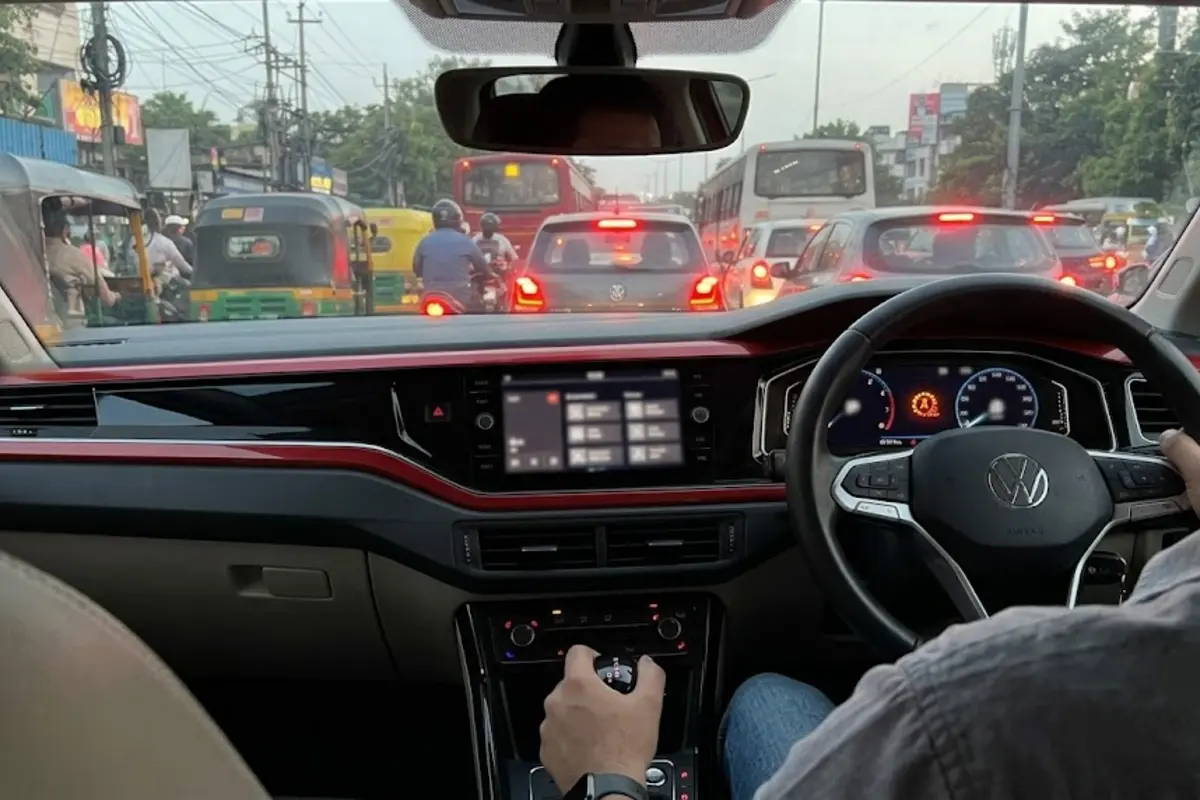
The Virtus DSG gearbox overheating warning appears in the owner’s manual as an automatic gearbox overheated warning with two stages. At the first, you may keep driving with caution. At the second, stop, switch off the engine and continue only after the light goes out. If it stays on, stop driving and call a specialist garage.
As of October 23, 2026, this guide covers today’s Virtus; the volkswagen virtus common problems guide covers recalls, service costs and the other faults owners report. Autocar India lists the Virtus facelift as upcoming, so details may change after launch. Confirm current details with Volkswagen India or an authorised Volkswagen service centre before you act on anything here.
If a gearbox message lights up while you sit in a traffic jam, you will probably reach for the manual. For the Virtus, it gives you clear steps and no cause. This guide sets out those steps, the stopping habits owners argue about, and what owners and testers report about the 1.5 TSI DSG. TSI is Volkswagen’s turbocharged petrol engine family. DSG stands for direct shift gearbox, a 7-speed automatic with two clutches that Volkswagen fits only to the 1.5 TSI. The 1.0 TSI automatic uses a torque converter, a conventional automatic that links engine and gearbox through fluid.
Gearbox warnings, brakes and steering belong with an authorised workshop. Every report below comes from an owner, a tester or an editor unless the text says the manual or Volkswagen states it. Facts were checked as of October 23, 2026.
Virtus DSG gearbox warning at a glance
The manual describes a two-stage gearbox warning and gives steps without a cause.
| Topic | What the sources show |
|---|---|
| Warning | A two-stage automatic gearbox overheated warning, described on page 88 of the owner’s manual |
| Steps | Drive on with caution at the first stage, and stop and switch off at the second |
| Cause and frequency | The manual gives neither, and no Virtus owner report of the message found |
| Cars covered | The 1.5 TSI DSG and the 1.0 TSI torque converter automatic |
| Stopping habit | The manual says to hold the car on the brake in drive for short stops and gives no advice to select neutral |
What does the Virtus gearbox overheated warning mean?
The Virtus owner’s manual lists an automatic gearbox overheated warning in two stages: drive on with caution at the first, and stop and switch off at the second.
| Stage | What the manual says to do |
|---|---|
| First | You may continue driving, exercising appropriate caution |
| Second | Stop the vehicle and turn off the engine, continue once the indicator light goes out, and if the light stays on, stop driving and seek a specialist garage |
According to the Virtus owner’s manual, the warning shows as an indicator light together with a message indicating gearbox overheating (page 88). The warning overview on page 11 lists the gearbox overheated warning twice, as two symbol entries that both point to page 88. A separate gearbox impaired warning on the same page covers emergency mode, which the manual does not define and which is usually understood as reduced power. In emergency mode you may continue with caution and should see a specialist garage as soon as possible. The other impaired message says not to continue driving.
On colour, Volkswagen’s general warning lights page lists a red warning for a DSG transmission that is too hot. That page covers Volkswagen cars generally and gives no steps, so match the symbol on your own cluster to your own manual. The engine coolant warning is a different entry (page 102): stop the engine, let it cool and continue after the light goes out.
The manual gives no cause, no prevention advice and no frequency for either gearbox warning. Checked against the manual edition dated December 21, 2023, as of October 23, 2026.
Does the warning apply to the 1.5 DSG only?
The manual’s overheated warning covers automatic gearboxes in general, so it applies to the 1.5 TSI DSG and to the 1.0 TSI torque converter automatic.
Power is listed in PS, the metric horsepower unit, and EVO is the 1.5 engine’s generation name.
| Engine | Power | Gearbox |
|---|---|---|
| 1.0 TSI | 115 PS | 6-speed manual or 6-speed torque converter automatic |
| 1.5 TSI EVO | 150 PS | 7-speed DSG |
According to Volkswagen India’s launch announcement, both rows hold true, and the Virtus brochure confirms the DSG name for the 1.5. Only the 1.5 TSI gets a DSG.
Owners and forum members call the 1.5’s gearbox a DQ200, a dry clutch unit whose clutches run without an oil bath. Volkswagen India’s documents say “7-speed DSG” and the manual says only “automatic gearbox”. DQ200 is an owner label that no Volkswagen source read confirms.
What should you do when the warning appears in traffic?
Follow the manual’s step for the stage on your display. Drive on with caution at the first stage. At the second stage, stop, switch off the engine and wait for the light to go out.
- Compare the symbol and message on your cluster with the two overheated entries on page 88 of the Virtus owner’s manual. The message wording is the same for both, and the symbol shown tells the stages apart. If you cannot tell which stage is lit, this guide’s own safe default, which the manual does not give, is to treat it as the second stage: stop safely, switch off and wait.
- At the first stage, keep driving with appropriate caution.
- At the second stage, stop the vehicle as soon as you can do so safely and turn off the engine.
- Wait for the indicator light to go out. The manual then allows the journey to continue.
- If the light stays on, stop driving and call a specialist garage.
Example: you are crawling in traffic and the light comes on. If the symbol matches the first entry on page 88, you keep moving with care and watch whether the light clears. If it matches the second entry, or you cannot tell (this guide’s default, not the manual’s), pull over when safe, switch off and wait for the light to go out.
Afterwards, write down the date, the place, how long the car sat in traffic, the speed and whether the light cleared. Photograph the display. Ask the workshop to read the fault codes, the error messages stored in the car’s control units, and to record them on the job card. The Virtus owner’s manual says an authorised garage saves service work in a Digital Service Plan, with the date of each job, in markets that offer it (pages 121 and 122). That gives you a dated history if the warning returns. These steps match the manual edition dated December 21, 2023.
How should you stop at junctions and in jams?
For a short stop the manual says to leave the selector lever in drive and hold the car with the brake pedal. For a full stop it says to use the brake, the parking brake, park and engine off.
| Situation | What the manual says |
|---|---|
| Stopping temporarily, for example at a junction | Leave the selector lever in drive and hold the car with the brake pedal |
| Stopping fully | Keep the brake pressed, apply the parking brake, select park and turn off the engine |
The Virtus owner’s manual adds that with the selector in a drive position or in manual shift mode, the car can move forward without warning, so keep your foot on the brake (page 87). On a slope of at least 5 percent, Hill Hold Control brakes the car for about 2 seconds after you release the brake pedal. That helps a hill start (page 92).
The manual gives no advice to select neutral at a stop or in bumper to bumper traffic. It describes the neutral position on page 87 and mentions it for towing on page 90.
Advice to shift to N at stops circulates on forums all the same. In an older Team-BHP thread from December 2011 about Skoda Laura and Superb owners, some members call neutral good practice for anything beyond a brief stop. Another member relays an unnamed claim that short stops do not need neutral. Members there say they found no official guidance. Those are other cars and other years, and the thread is opinion, so for the Virtus follow the manual, whose page 87 was read in full on October 23, 2026.
Why do owners say the Virtus DSG feels jerky in traffic?
Three owner reports describe hesitation, shuffling or high revs at low speed on the 1.5 DSG, and one Autocar India tester describes a hyperactive launch, across 2023 to 2026.
| Source | Car and distance | What is described |
|---|---|---|
| Team-BHP ownership review, 2023 | Virtus GT (a sportier trim) 1.5 DSG, about 2,000 km | Low-speed shifts in traffic feel quite jerky |
| Team-BHP one-year report, September 7, 2023 | Virtus GT, 14,277 km | The DSG gets confused in traffic, sometimes revving high before an upshift; the owner uses manual mode in traffic |
| Autocar India long-term report, January 20, 2024 | Virtus GT 1.5 DSG, about 12,000 km | A hyperactive gearbox off the line, with front-tyre chirp and torque steer (the steering tugging sideways under hard acceleration) |
| Team-BHP report at 12,000 km, October 13, 2026 | Virtus 1.5 DSG, nearly 12,000 km | Weakest in stop-start traffic, shuffles between first, second and third, small hesitation from standstill, a behaviour the owner calls no deal-breaker |
All four reports in the table describe behaviour. A breakdown, an emergency mode event and the overheated message appear in none of them. The October 2026 owner says his worry about long-term DQ200 reliability comes from other owners’ reviews, and he describes no failure on his own car.
No Virtus-specific dual clutch jerking fix was found. The owners in these reports cope or accept: one switches to manual mode in traffic, another accepts the shuffle. No source read mentions a gearbox software update. An older Team-BHP thread from May 2015 describes a Polo GT TSI with a 7-speed DSG that jerked at random, with 10 to 20 dealer visits and no fault codes found. The page read does not show the fix, and it concerns another car, so treat it as context. The newest report in the table is dated October 13, 2026, and all four were reread on October 23, 2026.
Is mechatronic failure a known Virtus DSG problem?
No Virtus owner report or Volkswagen statement about mechatronic failure surfaced, so the evidence for the Virtus is not found yet.
Forum members describe the mechatronic unit as the gearbox’s electro-hydraulic control unit, the part that combines electronics and hydraulics to select gears. In the 2011 Team-BHP thread, members argue over whether that unit is where Skoda DSG cars fail, and they offer opinion and anecdote without data. The May 2015 Team-BHP Polo thread concerns a different car and no fault codes. The Virtus reports in this guide describe behaviour, and the owner at nearly 12,000 km describes no failure.
A Volkswagen document, a service bulletin or workshop records would settle the question. Until one appears, treat mechatronic failure on the VW Virtus DSG as unconfirmed. If your Virtus shows a gearbox warning or drops into limited power, ask the workshop to read the codes. A search of owner reports and Volkswagen pages for this section ran on October 23, 2026.
Does heavy traffic wear a dry clutch DSG faster?
Autocar India’s editors say crawling puts more heat and wear on the 1.5 DSG’s dry clutches, but the piece is opinion about the Skoda Kushaq, a sibling car. The question behind DQ200 heating in bumper to bumper traffic is whether that crawling wears the clutches faster.
In a September 30, 2026 advice piece, the editors call the 7-speed DSG considerably sturdier than earlier generations. For a 50 km daily commute in moderate to heavy Chennai traffic, they suggest the 1.0 TSI automatic for peace of mind. They add that a buyer who wants the 1.5 DSG for its performance should keep that booking. A July 2, 2026 reader question about the Kushaq and the Volkswagen Taigun gets a similar answer. Current DSG units hold up much better than older ones, and a torque converter automatic suits mostly stop-start traffic better.
Neither Autocar piece cites failure data, mentions the Virtus or comments on neutral at traffic lights. Read both as editorial judgment from a respected source.
The Virtus owner’s manual, edition dated December 21, 2023, adds a small point. It lists frequent driving in stop-and-go mode, for example in city traffic, as an adverse operating condition that can call for some work before the next service date (page 122). It names the combined filter, air filter, timing belt, particulate filter and engine oil, and does not name the gearbox. Both Autocar pieces were reread on October 23, 2026.
Should you choose the 1.0 automatic or the 1.5 DSG for heavy traffic?
Choose the 1.5 DSG for the 150 PS performance if your driving mixes open roads with moderate traffic, and the 1.0 automatic if most of your trips crawl through jams.
Autocar India’s editors, writing about the Kushaq’s matching engines, point to the torque converter automatic for peace of mind in crawling traffic. That advice applies to you whether you are buying new or used. Whichever car you test, drive it through a good stretch of stop-start traffic, because owner reports describe slow-speed behaviour that a short loop never shows. Watch for jerks, hesitation or any gearbox message on the cluster.
A facelift is listed as upcoming, and no source read says whether it changes the gearbox or its warning logic. Ask the dealer which version you are getting. Everything in this guide describes cars built before any facelift.
What should you check or ask a workshop about the Virtus gearbox?
Ask for the gearbox fault codes to be read and recorded, and ask whether any software update applies to your Virtus. Keep every service record, and test the gearbox in stop-start traffic before you buy.
| Check | Why | How | Applies to |
|---|---|---|---|
| Fault codes | The manual gives no cause for the warning, so the stored codes are the best clue | Ask the workshop to read them and record them on the job card | Owners |
| Software update | No source read mentions a gearbox update | Ask whether any update applies to your VIN, the 17-character vehicle identification number | Owners, used buyers |
| Service history | A dated record shows past gearbox visits and warnings | Ask for every invoice and the Digital Service Plan record, if your market offers one | Used buyers |
| Low-speed behaviour | Owners describe shuffling and hesitation | Drive in stop-start traffic for a good stretch | New and used buyers |
| Warning on the cluster | A lit gearbox symbol needs an explanation | Switch the ignition on, watch the cluster, and ask what each symbol means | New and used buyers |
Questions here carry no claimed fixes, since none was found. Each row traces to the manual and owner reports cited in this guide, read on October 23, 2026.
Virtus DSG gearbox overheating warning: rules you need to follow
Five rules cover the evidence.
- Read the stage on your display and follow the manual’s stop or continue step exactly.
- Treat a lit gearbox warning as a reason to see a specialist garage if the light stays on.
- Hold every stop on the brake as the manual says, and use park with the parking brake for a full stop.
- Write down the date, place, traffic and speed whenever the warning appears.
- Treat owner and forum reports as reports, since they show what can happen to some cars.
The Virtus DSG gearbox overheating warning has clear manual steps and no published cause, so these five rules are the safe route. For recalls, service costs and the other faults owners report, read the full guide to volkswagen virtus common problems.
Looking for your next car, the latest auto updates, or practical tips to keep your vehicle in top shape? Explore expert insights and helpful guides at Hub N Wheels, and check out our latest car maintenance tips to keep your vehicle running smoothly.
FAQs
A. The manual lists an automatic gearbox overheated warning in two stages. At the first stage you may continue driving with appropriate caution. At the second stage you must stop, switch off the engine and continue only after the light goes out. If the light stays on, stop driving and call a specialist garage. The manual gives no cause for the warning.
A. The message wording is the same for both stages, so check the symbol. The manual shows two overheated entries, one for each stage, each with its own symbols beside it. Match the symbol on your cluster to the entry. If you cannot tell, this guide’s own default, which the manual does not give, is to stop safely, switch off and wait.
A. Only at the first stage, and only with appropriate caution. At the second stage the manual says not to continue driving: stop the car, turn off the engine and wait for the light to go out. If the light stays on after that, stop driving and seek a specialist garage.
A. The manual says to leave the selector in drive and hold the car on the brake pedal for a short stop. For a full stop it says to hold the brake, apply the parking brake, select park and turn off the engine. The manual gives no advice to select neutral at a stop, and older forum opinion about other cars is split.
A. Editors rate the 1.0 torque converter automatic calmer when crawling, while owners call the 1.5 DSG quick but sometimes jerky at low speed. Neither choice comes with failure data. New and used buyers should drive both through stop-start traffic and watch for hesitation, jerks or any gearbox message before deciding.
A. No Virtus owner report or Volkswagen statement about mechatronic failure showed up as of now, so the evidence is none found. The mechatronic unit is the gearbox’s electro-hydraulic control unit. If your Virtus shows a gearbox warning or drops into limited power, ask the workshop to read the fault codes and record them.