
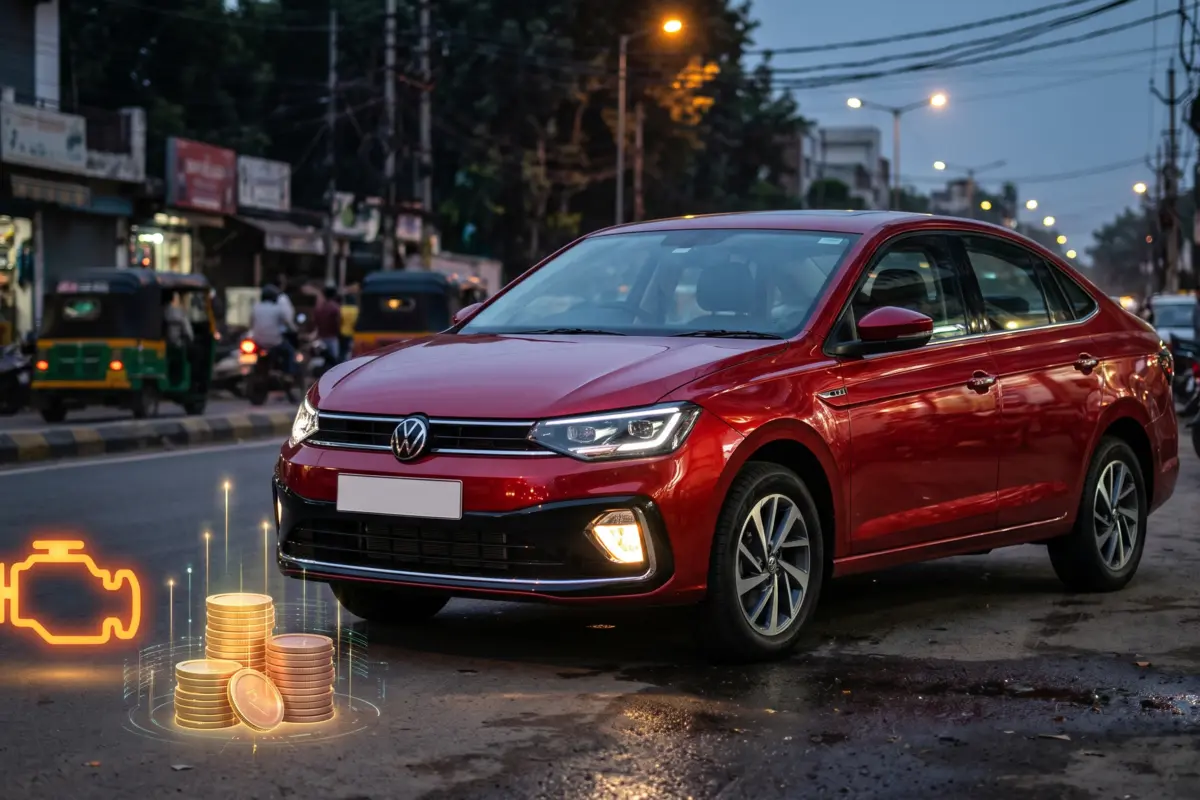
Volkswagen Virtus common problems reported by owners include the EPC (electronic power control) warning with start-stop errors on the 1.0 TSI (turbo) and jerky 1.5 DSG (direct shift gearbox) shifts in slow traffic. Owners report steering pull and window faults. No source gives failure rates, so test in traffic and take warning lights to a workshop.
A warning light on a cold morning, a gearbox that shuffles through a traffic jam, a used Virtus you are about to buy: each raises one question: real fault or normal behaviour? This guide sorts reported Virtus issues by how much evidence stands behind them, using five labels explained below. The fault sections also separate what the owner’s manual says from what owners report.
As of October 21, 2026, Autocar India still lists the Virtus facelift as upcoming, so this guide covers the Virtus currently on sale in India. Confirm current details with Volkswagen India or an authorised Volkswagen service centre before you act on any figure here.
Every problem below is a report from an owner, a tester or a news outlet unless the text says the manual or Volkswagen documents it. Warning lights, brakes, steering and airbags belong with an authorised workshop. Facts were checked as of October 21, 2026.
Volkswagen Virtus common problems and facts at a glance
| Topic | What the sources show |
|---|---|
| Engines | 1.0 TSI (turbocharged petrol, 115 PS, metric horsepower) and 1.5 TSI EVO (150 PS; EVO is the engine’s generation name), per Volkswagen India’s launch announcement |
| Most reported fault | EPC light with a start-stop error, every report that names a variant names the 1.0 TSI |
| Gearbox | The manual documents a two-stage overheated warning for its automatic gearboxes; owners describe jerky 1.5 DSG shifts in slow traffic |
| Recalls reported | Three limited recalls reported between November 2024 and July 2025 |
| Service interval | 1 year or 15,000 km, whichever comes first |
| Warranty | 4 years or 100,000 km, extendable |
| Crash safety | Five stars from Global NCAP, an independent crash-test programme, in 2023 |
Which Volkswagen Virtus do you own?
Indian Virtus buyers choose between the 1.0 TSI (115 PS) and the 1.5 TSI EVO (150 PS), and the gearbox you own decides which problems apply to you.
According to Volkswagen India’s launch announcement, the 1.0 TSI comes with a 6-speed manual or a 6-speed torque converter automatic. The 1.5 TSI comes with a 7-speed DSG. The Volkswagen India Virtus brochure confirms the DSG name for the 1.5. A torque converter automatic is a conventional automatic that couples engine and gearbox through fluid.
| Engine | Power | Gearbox |
|---|---|---|
| 1.0 TSI | 115 PS | 6-speed manual |
| 1.0 TSI | 115 PS | 6-speed torque converter automatic |
| 1.5 TSI EVO | 150 PS | 7-speed DSG |
Every owner report of the EPC light with a start-stop error that names a variant names the 1.0 TSI. Reports of jerky low-speed shifting come from 1.5 DSG owners. Reports in this guide describe cars built before any facelift.
How this guide labels evidence of the problems reported in the Volkswagen Virtus
Each problem carries one of five labels, so you can see how much weight a report deserves.
- Documented by Volkswagen: stated in the owner’s manual or on a Volkswagen India page.
- Several reports: three or more separate owners or outlets describe it.
- Few reports: two separate sources describe it.
- Single report: one owner or one test car.
- None found: searched for, with no source located.
Owner reports show that something happens to some cars. No source read for this guide publishes a failure rate, so no report here tells you how many cars are affected.
What are the most common Volkswagen Virtus problems?
Owner reports point to the EPC light with start-stop errors, jerky DSG shifts in slow traffic, a pull to the left, window faults and weak air conditioning. No Volkswagen document read for this guide confirms any of them as a known fault.
| Issue | What owners and testers describe | Variant named | Evidence |
|---|---|---|---|
| EPC light with start-stop error | Warning on cold mornings after idling, misfire codes (a cylinder failing to burn its fuel properly), long crank (the engine turns for seconds before it starts) on some cars | 1.0 TSI (owners of the Taigun SUV and Polo hatchback with the 1.0 TSI report similar) | Several reports |
| Jerky DSG in slow traffic | Shuffling between gears, high revs before an upshift, hesitation from standstill | 1.5 TSI DSG | Several reports; the manual documents a gearbox overheated warning |
| Driver’s window fails or bounces back | Stops halfway up, fails to close fully, bounces back after a software update | 1.5 TSI (manual and DSG) | Several reports |
| Pull to the left or heavy steering | Heavy steering, especially on turns and at speed | 1.0 automatic and unspecified | Few reports, unresolved |
| Hissing or weak air conditioning | Occasional hiss, slow cooling in summer | 1.5 TSI | Single reports |
| Water in the driver’s footwell | Water from an air conditioning line, first seen as an airbag warning light | Virtus GT (the sportier trim) | Single report |
| Wireless charger and Android Auto | Charger stops at random, Android Auto drops when the horn sounds | Virtus GT 1.5 DSG | Single report |
| Boot lid | Stays open only if pushed fully back and held | Virtus GT 1.5 DSG | Single report |
| Fast tyre and brake wear | Front tyres wore a little quicker than usual, brakes nearly worn out at the end of a 15-month test | Virtus GT 1.5 DSG | Single report |
Read the table as a map of what to check. How often each issue occurs is unknown, so the row order carries no ranking. Two patterns recur across sources: the EPC light on the 1.0 TSI and the 1.5 DSG’s behaviour in slow traffic. Both get their own sections below.
Why does the Volkswagen Virtus EPC light come on?
The Virtus owner’s manual indexes EPC and describes the warning as a fault in the engine control system, and owners link it to cylinder misfires on the 1.0 TSI.
The light tells you that the engine management system has logged a fault, and the cause varies from car to car.
What the manual mentions about the EPC light
The Virtus owner’s manual lists the light as a fault in the engine control system (pages 102 and 103). The car can be driven in emergency mode (a limited-power mode), and the manual warns of a noticeable drop in engine performance. If the light comes on, the manual tells you to continue with appropriate caution and seek help from a specialist garage. It gives no list of causes. A separate emission control system fault carries the same advice.
What owners report in the Volkswagen Virtus
Reports of the EPC light with a start-stop error come mostly from the 1.0 TSI and its Taigun and Polo siblings, and the dealer fixes tried vary.
| Report | Car | What the owner describes | Dealer action reported |
|---|---|---|---|
| Team-BHP news report and the Team-BHP forum thread, April and May 2024 | Virtus bought October 2022, engine not stated | EPC light and start-stop error on cold mornings after idling; restarting clears the light, the start-stop error stays until the car has been driven | Fuel injectors changed, then twice more; hydraulic lash adjuster (HLA) changed; software updated; fault still present at the time of posting |
| Team-BHP thread, page 2, May 2024 update | Virtus bought October 2022, same owner | Misfire found in cylinder 3, then cylinder 1 on a rescan; no issue for 10 days after the car came back | HLAs for cylinders 1 and 2 planned; warranty extended to 2028 |
| Team-BHP EPC thread, May 2024 | Taigun 1.0 TSI | EPC code plus start-stop error on a morning run | Service centre cleaned the rail pressure sensors (fuel pressure sensors on the injector rail); error cleared, owner expects it to return |
| Team-BHP EPC thread, June 2024 | Polo 1.0 TSI | Cranked only on the first start, then EPC light and a second-attempt start | Low-pressure fuel pump replaced earlier under warranty; sensors and pressures looked normal; engine control unit (ECU) software updated |
| Team-BHP EPC thread, June 2025 and September 2026 | Taigun 1.0 TSI, about 32,000 km at the first event | Power loss and jerking at 40 to 50 km/h with a cylinder 3 misfire; in September 2026 similar symptoms at crawling speed and long idling, with misfire in all three cylinders | Spark plugs replaced for about Rs 3,000 with labour after the advisor cited carbon on the plugs; the owner asks what the final fix was |
| Team-BHP EPC thread, January 2026 | Virtus 1.0 Topline AT (top trim, automatic gearbox), about 31,000 km | Intermittent EPC with reduced power and mild vibration, mostly under load; the owner’s own scan of the on-board diagnostic (OBD) port showed a cylinder 2 misfire code | Technician suspected plugs or an ignition coil; outcome pending |
| Team-BHP news report, May 4, 2026 | Virtus HL (Highline trim) 1.0 TSI, bought October 2024, about 7,096 km | Random long crank of 5 to 6 seconds with no fault codes | High-pressure fuel pump replaced under warranty, then a leaking cylinder 3 injector and a fouled plug found and replaced; the owner reports a rougher engine afterwards |
Parts replaced across these reports include injectors, lash adjusters, spark plugs, two kinds of fuel pump and sensors, with mixed results. Several owners describe the issue, and none of the sources read shows a Volkswagen statement, service bulletin or root cause. Ten days without a recurrence is too short to call any fix proven.
Which petrol grade does the Volkswagen recommend for the Virtus?
On petrol grade, the manual’s fuel and octane section gives RON 95 (research octane number, the rating of a petrol’s grade) as the specified petrol and recommends 95 octane (page 104). It accepts petrol of at least 91 octane with a minor power loss and slightly higher fuel use, and it bans anything below 91. The wording lists both 95 and 91, so read 95 as the target and 91 as the floor.
If your tank holds lower octane than specified, the manual tells you to drive at mid-range engine speeds with minimal strain. Refuel with the specified grade as soon as possible. It also asks for unleaded petrol that meets the Indian E10 or E20 standard, meaning petrol blended with 10 or 20 percent ethanol. The bioethanol limit is printed on the label inside the fuel filler flap or cap (pages 104 and 105). A separate warning says never to run the tank completely empty (page 103).
Fuel grade connects to power and consumption in the manual, and no passage links it to the EPC light. Forum members are split on the question. In the EPC forum thread, the original poster reports the fault on both 91 and 95 octane. A Taigun owner reports no recurrence after replacing a sooty spark plug and switching from XP95 to 91 octane petrol. Single reports pulling in opposite directions establish no link between octane and the EPC light.
The regular E20 blended petrol now has an Octane rating of ~98 due to higher ethanol content. It is great for turbo GDI gasoline engines by further reducing the chances of engine knocking. However, E20 fuel has shown to reduce the fuel economy because of lower energy content and may affect both the low-pressure and high-pressure fuel pumps, fuel lines and the injectors if they are not E20 material compliant.
How idle start-stop system fits in
START-STOP is the system that switches the engine off at a stop. According to the manual’s START-STOP page (page 86), the engine switches off only under set conditions. The driver’s door must be closed, the driver’s seat belt fastened, and the car must have exceeded 4 km/h since the last stop. The manual adds that some conditions come from the car’s own systems and cannot be influenced, so the system may react differently in situations that look identical. If your start-stop stays idle at one junction and works at the next, those conditions can explain it.
Two normal behaviours also raise worry, and the manual lists both. The radiator fan can run for about 10 minutes after the engine stops. A short burst of higher revs after a cold start makes the engine louder (page 85).
When to go to a workshop
Take the car in when the light stays on after a restart, when power drops, or when the engine shakes. Photograph the display and write down the date, the speed, the weather, how long the car idled and when you last refuelled. Ask the workshop to read the fault codes and to record them on the job card. The manual says an authorised garage stores each service job in a Digital Service Plan where the market supports it (pages 121 and 122). That gives you a dated history if the fault returns.
The newest EPC report in the table is dated September 2026, and forum threads keep updating, so recheck before relying on any single case.
Is the Volkswagen Virtus DSG transmission a problem?
The Virtus 1.5 TSI DSG draws more complaints about low-speed behaviour than about failures, and the sources read contain no failure data.
What DSG means
DSG is the 7-speed automatic transmission that Volkswagen India sells with the 1.5 TSI engine only. The 1.0 TSI automatic is a 6-speed torque converter (expected to be an 8-speed torque converter unit in the upcoming facelift), a different design. Owners and forum members call the 1.5’s gearbox a DQ200, a dry clutch unit whose clutches run without an oil bath. Volkswagen India’s documents say “7-speed DSG”, and the owner’s manual says only “automatic gearbox”. The DQ200 label is Volkswagen’s internal naming for the transmission.
What the manual says about gearbox warnings
Page 88 of the manual’s gearbox troubleshooting section describes a gearbox overheated warning with two stages. It sits in the general automatic gearbox section, so it covers the 1.0 automatic as well as the 1.5 DSG. In the first stage you may continue driving with appropriate caution. In the second, the message says to stop driving: stop the vehicle and turn off the engine. Continue only after the indicator light goes out. If the light stays on, seek a specialist garage. A separate gearbox malfunction warning covers emergency mode. One version tells you to seek a garage as soon as possible. Another tells you to stop driving.
At a brief stop at a junction, the manual tells you to leave the selector in drive and hold the car with the brake pedal. For a full stop it says to hold the brake, apply the parking brake, select park and turn off the engine (page 87).
No cause, prevention advice or frequency appears in the manual for the overheated warning. Evidence label for an owner-reported overheated message: none found. No owner report of seeing it turned up in the forum threads, long-term reviews and news pieces read for this guide.
What owners and testers describe about the Virtus
| Source | Car and distance | What is described |
|---|---|---|
| Team-BHP ownership review, August 2023 | Virtus GT 1.5 DSG, about 2,000 km | Low-speed shifts in traffic feel “quite jerky” compared with a Skoda Kodiaq |
| Team-BHP one-year report, September 7, 2023 | Virtus GT, 14,277 km | The DSG gets confused in traffic and low-speed driving, sometimes revving high before an upshift; the owner uses manual mode in traffic |
| Autocar India long-term report, January 20, 2024 | Virtus GT 1.5 DSG, about 12,000 km | A “hyperactive” gearbox; green-light launches brought front-tyre chirp and torque steer (the steering tugging sideways under hard acceleration), described as character |
| Team-BHP report at 12,000 km, October 13, 2026 | Virtus 1.5 DSG, nearly 12,000 km | Weakest in stop-start traffic, shuffles between first, second and third, small hesitation from standstill, “not a deal-breaker” |
All four sources describe behaviour: shuffling, hesitation and early revving. Breakdowns, emergency mode events and the overheated message are absent from all four. The owner in the October 2026 report says his worry about long-term DQ200 reliability comes from other owners’ reviews and that nothing has failed on his car. In the Team-BHP ownership thread, one member calls DQ200 failure risk the single major downside of the car. Another criticises Volkswagen over a known issue. Both posts offer opinion without failure figures.
Opinion on crawling traffic
Autocar India’s advice piece on the Skoda Kushaq, published September 30, 2026, covers the same 1.5 TSI DSG family as the Virtus. The editors call the 7-speed DSG far sturdier than earlier generations. It remains a dry clutch unit, they say, and repeated crawling puts more heat and wear on the clutches. For a reader with a 50 km daily commute in moderate to heavy Chennai traffic, they suggest the Kushaq’s 1.0 TSI automatic. The piece cites no failure data, so the heat and wear point is editorial judgment.
Choosing between the 1.0 automatic and the 1.5 DSG
Choose the 1.5 DSG if you want the 150 PS pull and your driving mixes open roads with moderate traffic. Choose the 1.0 automatic if most of your trips crawl through jams. Autocar India’s editors, writing about the Kushaq’s matching engines, rate the torque converter automatic calmer at crawling speeds. Whichever you test, drive it in stop-start traffic for a good stretch, because the reports describe slow-speed behaviour that a short loop never shows. The 1.0 automatic also costs more at two service milestones, covered in the service cost section below.
The manual edition is dated December 21, 2023, and the newest DSG report above is dated October 13, 2026.
Why does the Volkswagen Virtus pull to the left or feel heavy to steer?
Two owner threads report a Virtus that pulls left or steers heavily, and the fixes tried include tyre pressure correction, wheel alignment and steering angle sensor calibration.
In a Team-BHP thread from February 2023, an owner describes steering that feels very heavy turning left and very light turning right at speed. According to the owner, the service centre shifted the subframe (the frame that carries the engine and suspension) several times. A technician said he had calibrated the steering angle sensor, yet handling still felt wrong. Members advised an alignment check at a reputable centre and an inspection of tyre wear. The first page of that thread shows no resolution.
A July 2024 Team-BHP thread covers a Virtus 1.0 automatic bought in September 2023. Its steering turned heavier and less smooth over a few months, most noticeably in U-turns. Two service centres found the steering fine and offered a tyre pressure correction. A member suggested a new car’s tyres and suspension may still be settling and advised an independent alignment check. Another owner in the same thread reports a wobble that led the service centre to start a warranty driveshaft replacement.
On tyre pressure, the manual’s tyre section tells you to check pressure in all tyres with the tyres cold, at least once a month and before each long journey. Save the new values in the tyre monitor after any change (pages 115 and 116). The label with the specified pressures sits on the central body pillar on the driver’s side. The manual’s Wheels chapter lists incorrect tyre pressure, driving style, wheel alignment and wheel balancing as causes of uneven tyre wear. It recommends changing wheel positions every 10,000 km.
A power assisted steering fault warning appears in two states (page 33). For total failure of assistance, turn the ignition off, start the engine and drive a few metres. If the light stays on, stop driving and seek a specialist garage. For partial failure, the same restart applies, and if the light stays on you may continue with caution while arranging a garage visit.
Start with tyre pressure on cold tyres, then ask an independent alignment centre for a before and after printout. Leave anything beyond tyre pressure to a workshop, since steering is a safety system.
Evidence level for this section: few reports, both unresolved on the pages read.
What smaller electrical and comfort faults do owners report?
Owners and testers report window faults, a hissing or slow air conditioner, a wireless charger that stops and Android Auto drops. Software updates are the fix most often mentioned.
| Fault | What reports say | What the manual says | Evidence |
|---|---|---|---|
| Driver’s window | Sometimes fails to close fully (Team-BHP, July 2023); fails halfway up (Autocar India, January 2024); bounces back after a software update, fixed by re-flashing (CarToq long-term owner report) | Force limiter and a reactivation routine after a battery disconnect | Several reports |
| Air conditioning | Occasional hiss; slow cooling in stock form in hot summers, improved by window film (Team-BHP, July 2023 for the hiss; Team-BHP, October 2026 for the cooling) | Water dripping from the system when cooling runs is no leak, per the manual | Single reports |
| Water in the driver’s footwell | Water from an air conditioning line behind the pedals, noticed through an airbag light; 15 days at the workshop (CarToq owner video review) | No description | Single report |
| Wireless charger | Refuses to charge at random (Autocar India long-term report) | Conditions and a reset by switching the ignition off and on | Single report |
| Android Auto | Disconnects when the horn sounds (Autocar India long-term report) | No description | Single report |
| Boot lid | Stays open only if pushed fully back and held for a few seconds (Autocar India long-term report) | No description | Single report |
Window bounce back and one-touch faults
Pages 26 and 27 of the manual’s window section describe a force limiter on the driver’s window. When it meets an obstacle the glass retracts several centimetres. If the obstacle blocks it again within 10 seconds, the glass retracts once more. After a third attempt within the next 10 seconds the limiter stops operating, and the window closes at full force. One line in that passage says the closing process will be stopped instead. The manual cautions you to close the driver’s window carefully even so. It adds that the regulator can stop working after repeated opening and closing, when the mechanism may be overheated, and that it needs time to cool.
After the 12V battery has been disconnected, the manual gives a reactivation routine. Switch the ignition on, push the window button up until the window closes, and release it. Then push it up again and hold for 1 second. The manual describes no bounce back without an obstacle and none after a software update, so the CarToq case rests on that single owner’s account.
Air conditioning
Water can drip from the air conditioning system when cooling runs, and the manual’s heating and air conditioning chapter says this is no leak (page 55). Water inside the cabin is a different matter and needs a workshop. The chapter also says the cooling system can switch off automatically when coolant temperature is too high. It recommends keeping the cabin no more than 5 degrees Celsius cooler than the outside air.
Owner reports on cooling vary. An owner at nearly 12,000 km reports that stock air conditioning struggled in Andhra Pradesh summers and needed a setting of 22 or 23 in Auto. Window films improved cooling (Team-BHP report at 12,000 km). Another one-year owner reports no air conditioning issues and says the cabin cools a minute or two slower than in Korean or Japanese cars (Team-BHP one-year report).
Wireless charger
For the charger, the manual’s wireless charging page (pages 119 and 120) lists the working conditions: ignition on, a Qi phone (one that supports the Qi wireless charging standard), nothing between phone and pad. It advises placing the phone screen up, without a protective case, centred on the symbol. Switching the ignition off and on reactivates charging that was cancelled on screen. Autocar India notes that some electrical gremlins may clear with a software update and leaves open whether the charger fault did.
Reports in this section range from July 2023 to October 2026, and the manual edition is dated December 21, 2023.
Are there any Volkswagen Virtus recalls in India?
Three limited recalls have been reported for the Virtus, covering a suspension arm weld, rear seat belt parts and a cracked seat belt frame. They span 38, 21,513 and 961 units respectively, counting Taigun and Virtus together.
| Reported | Units | Build range | Defect | Remedy as reported |
|---|---|---|---|---|
| November 15, 2024 (Rushlane on the 38-unit recall) | 38 Volkswagen units (Taigun and Virtus) | November 29, 2023 to January 20, 2024 | Possibly missed weld on the track control arm | Repair or replacement at no cost |
| April 30, 2025 (The Week, PTI and Rushlane on the seat belt recall) | 21,513 Taigun and Virtus units | May 24, 2024 to April 1, 2025 | Rear seat belt parts | Owners contacted through service centres; parts likely replaced free |
| July 18, 2025 (Rushlane on the July 2025 recall) | 961 Taigun and Virtus units | December 2021 to May 2025 | Crack in the metal base frame of the rear seat belt assembly; incorrect part in the front and rear seat belts | Repair or replacement likely free, unconfirmed |
Each recall applies by build range and VIN (vehicle identification number, the 17-character code on your car), so your own VIN settles the question. Rushlane’s July 2025 report says owners can check eligibility by entering the VIN. Ask an authorised service centre to confirm in writing that no campaign is open on your VIN, and repeat the check at each service.
All three entries come from news outlets that cite the industry’s voluntary recall listing or Volkswagen notices. The manufacturer’s own notices stayed unopened for this guide, so the list may be incomplete. Rushlane’s July 2025 report gives no description of the risk. The unit counts combine Taigun and Virtus with no Virtus-only split, and Skoda units in the same campaigns are counted separately.
Recall details are as reported by the three outlets above, read on October 21, 2026.
What is the Volkswagen Virtus service schedule and maintenance cost?
Volkswagen India lists a service interval of one year or 15,000 km, whichever comes first. Published estimates put the first Virtus service between roughly Rs 4,300 and Rs 5,600.
According to Volkswagen India’s maintenance page, your Virtus falls due for service every year or 15,000 km. The page states no prices and links to a service cost calculator.
Beyond the interval, the manual’s service section (pages 121 and 122) adds that a fixed or a variable interval applies, depending on equipment, engine type and operating conditions. The garage tells you which one. A variable interval brings the oil change when the car needs it and uses LongLife engine oil. The manual lists frequent stop-and-go driving in city traffic as an adverse condition. Adverse conditions can pull some work, such as the air filter and engine oil, ahead of schedule. It recommends leaving resets of the service indicator to the workshop, because a wrong reset can set incorrect intervals.
Volkswagen Virtus service cost estimates by source
Two published tables give per-service estimates, and they disagree. The compiled comparison below was built on October 21, 2026 from both pages. CarDekho’s service cost table is dated March 19, 2023, covers Delhi and excludes taxes. V3Cars’ service cost table shows no date and no statement about GST.
| Engine and gearbox | First service, CarDekho | First service, V3Cars | Five services, CarDekho (sum of services 1 to 5) | Five services, V3Cars (page total) |
|---|---|---|---|---|
| 1.0 TSI manual | Rs 4,336 | Rs 5,114 | Rs 33,899 | Rs 41,141 |
| 1.0 TSI automatic | Rs 4,336 | Rs 5,114 | Rs 42,548 | Rs 51,993 |
| 1.5 TSI DSG | Rs 4,734 | Rs 5,565 | Rs 35,945 | Rs 45,102 |
Both sources show the 1.0 automatic costing the most over five services and the 1.0 manual the least, with the 1.5 DSG in between. CarDekho’s ten-service totals are Rs 76,388 (1.0 manual), Rs 93,520 (1.0 automatic) and Rs 81,386 (1.5 DSG).
Why the VW Virtus 1.0 TSI automatic service costs more
The extra cost lands at the fourth and eighth services. CarDekho prices the fourth service at Rs 18,400 for the 1.0 automatic against Rs 9,585 for the manual. It lists the automatic transmission fluid change at Rs 8,647. V3Cars shows Rs 23,582 against Rs 12,536 for the same service. CarDekho adds that the fourth and eighth services include spark plugs and a poly V-belt on all three versions.
What the VW Virtus service estimates leave out
CarDekho calls its figures tentative and says real costs vary by vehicle, dealer and location. V3Cars’ figures sit above CarDekho’s at every one of the first five services. The gap is Rs 778 to Rs 831 at the first service and up to about Rs 5,200 later. Neither page says where its numbers come from.
The launch package includes three labour-free services, and the brochure lists them at 1,000 km, 7,500 km and 15,000 km. Both cost tables show zero labour at the first service, which is consistent with that offer. The Volkswagen India service value package page says the package covers up to 60,000 km or four services, whichever is earlier, and gives no price. That page is undated and says offers are being updated.
A worked example for a Virtus 1.5 DSG owner
Take a Volkswagen Virtus owner who services once a year and covers 12,000 km. Five services come to about Rs 35,945 to Rs 45,102 on these two tables, or roughly Rs 7,200 to Rs 9,000 a year. At 10 to 11 km/l, the same 12,000 km needs about 1,090 to 1,200 litres of petrol. Multiply that by the pump price you pay, then add tyres, insurance and any repairs. The average hides an uneven spread, since the fourth service costs far more than the first, and it assumes no extra work beyond the schedule.
1.0 TSI vs 1.5 TSI running costs: service gap and owner fuel figures
Comparing the 1.0 manual with the 1.5 DSG, published service estimates differ by little. CarDekho puts five services at Rs 33,899 for the 1.0 manual against Rs 35,945 for the 1.5 DSG, a gap of Rs 2,046. V3Cars puts them at Rs 41,141 and Rs 45,102, a gap of Rs 3,961. The 1.0 automatic sits above both, as the table shows.
Fuel adds to the running cost, and owner averages land close together. A two-year Team-BHP review of a Virtus 1.0 TSI manual logged 14,320 km at an average of 10.62 km/l on 99 percent XP95 petrol. The best figure was 22.57 km/l and the worst 8.27 km/l. A one-year review of the Virtus GT reports 10 to 11 km/l in heavy Pune traffic. A GT Plus manual owner says city driving needs a changed driving style to beat 10 km/l and reports 10.7 km/l on a long highway trip. Fuel type, roads and driving style differ between the three, so treat the numbers as a rough guide to both engines.
The service estimates are third-party figures dated March 2023 (CarDekho) or undated (V3Cars), so replace them with a current quote from your authorised service centre.
What does the Volkswagen Virtus warranty cover?
The Virtus manual gives the India warranty as 4 years or 100,000 km on new cars and 2 years on the 12V battery. Launch documents add extensions up to 7 years, and exact terms depend on your purchase contract.
| Cover | Term | Source |
|---|---|---|
| Standard warranty, new car | 4 years or 100,000 km | Owner’s manual, page 146 |
| 12V battery | 2 years | Owner’s manual, page 146 |
| Paint defects | 3 years | Owner’s manual, page 146 |
| Rust-through (India) | 6 years | Owner’s manual, page 146 |
| Extended warranty | Up to 7 years; the Virtus brochure from Volkswagen India gives 7 years or 150,000 km | Launch announcement and brochure |
| Roadside assistance | 4 years, extendable to 10 | Volkswagen India launch announcement |
Rust-through means perforation of the sheet metal from the inside, from the cavities outward, in the manual’s definition. Before you file a paint or body claim, note the three exclusions the manual lists (page 147). They are damage from external influences or insufficient care, defects repaired late or outside the maker’s rules, and rust linked to repairs that broke those rules. The manual also warns that skipping service intervals can damage the car and void the warranty (page 121), so the dated service history matters for any claim.
One owner in the EPC thread reports a warranty extension to 2028 on a car with repeat visits. Treat that as a single owner’s account of a dealer decision and ask your own dealer what applies to your VIN.
Evidence label: documented by Volkswagen. Warranty terms come from a manual dated December 21, 2023 and launch-era documents, so confirm current terms and extension prices with a dealer.
Is Volkswagen Virtus a reliable car?
The evidence on Virtus reliability is mixed and thin: some owners report trouble-free years, others report repeat workshop visits, and no failure-rate data exists in any source read.
| Points in its favour | Points against | Unknown |
|---|---|---|
| A two-year 1.0 TSI manual owner reports 14,320 km with no faults described (Team-BHP two-year review) | Repeat workshop visits for the EPC light on the 1.0 TSI, with several parts replaced | Failure rates for any part |
| Autocar India’s 15-month, 12,000 km Virtus GT report mentions no workshop visit for a fault, though it lists minor faults | Three limited recalls in 2024 and 2025 | Whether the 1.0 TSI or the 1.5 TSI is more affected |
| A CarToq owner video review at about 47,000 km in a year calls the car reliable apart from a few minor issues | Forum fear of long-term DQ200 trouble on the 1.5 DSG, offered as opinion | Root cause of the EPC reports |
| Window faults reported by several owners, and air conditioning, charger and Android Auto faults by single reports | How often the gearbox overheated message appears |
The five-star Global NCAP result belongs in a separate column. Global NCAP announced the Virtus result on April 4, 2023 with five stars for adult and child occupant protection. Rushlane’s report of the test gives 29.71 of 34 for adults and 42 of 49 for children as a combined figure for the Virtus and the Slavia. It says the test car had dual front airbags, belt pretensioners and standard ESC (electronic stability control). The star rating measures crash protection only.
The brochure says the Virtus has up to six airbags, so confirm the airbag count for the exact variant you are buying.
Judge a Virtus by three things: the engine and gearbox, the way the car behaves in your own traffic, and how its workshop handled any past fault. Those three decide more than any single report.
Reliability notes here summarise the sources above as read on October 21, 2026.
What should you check yourself before a workshop visit?
Check tyre pressure cold and use the petrol grade the manual specifies. Log each warning light with the conditions around it, and leave service resets and safety systems to the workshop.
- Tyre pressure. Check all tyres cold at least once a month and before long journeys. Read the values from the label on the driver’s side central pillar. Save them in the tyre monitor after any change (pages 115 and 116 of the Virtus owner’s manual).
- Petrol. Use RON 95 petrol that matches the ethanol label inside the fuel filler flap or cap. Add no extra additives to compliant petrol, and avoid running the tank empty (pages 103 to 105).
- Engine oil. Check the level regularly on level ground with the engine off and at operating temperature. The manual says the engine may use up to 0.5 litre per 1,000 km, with more in the first 5,000 km (page 100).
- Warning log. Record the date, time, speed, weather, fuel and whether the light cleared after a restart, and photograph the display. These details help a workshop reproduce an intermittent fault.
- Normal behaviours. The radiator fan can run for about 10 minutes after switch-off. The engine sounds louder briefly after a cold start (page 85). Water can drip from the air conditioning when cooling runs, and the manual says it is no leak (page 55).
- Break-in. New brake pads give less than optimum braking for the first 800 km, and new tyres give less than optimum grip for the first 500 km. Drive with extra care after a change (page 13).
Items 1 to 3, 5 and 6 come from the manual edition dated December 21, 2023, and item 4 is practical advice for workshop visits.
What should you check when buying a used Volkswagen Virtus?
Before buying a used Virtus, ask for service records that show every EPC or misfire visit. Test the gearbox in slow traffic, try every window, check the VIN against recall pages and match the airbag count to the variant.
| Check | Why | How |
|---|---|---|
| Service history and job cards | EPC reports involve repeat visits and several parts | Ask for every invoice and the printed Digital Service Plan record the manual recommends after each service (page 121) |
| Cold start | EPC and long-crank reports centre on cold mornings | Ask to see the car started cold, before anyone has run it, and listen for a crank that drags for several seconds |
| Warning lights | A light that stays on after start-up needs an explanation | Switch the ignition on and watch the cluster; ask the seller what each lit symbol means |
| Gearbox in traffic (1.5 DSG) | Owners describe shuffling and hesitation at low speed | Drive in stop-start traffic for a good stretch and watch for jerks, hesitation or any gearbox message |
| Steering and tyres | Pull and heavy steering reports are unresolved | Drive a straight, flat road, check front tyre wear and ask for an alignment printout |
| Windows, air conditioning, charger | Several window reports; air conditioning and charger reports | Run each window up and down, run the air conditioning on a warm day, look for water in the driver’s footwell, test the wireless charger and the boot lid |
| Recalls and warranty | Three recalls apply by build range and VIN | Run the VIN through a recall check and ask what warranty remains of the 4 years or 100,000 km base term, with service history to support it |
| Airbags | The brochure says up to six; the Global NCAP test car had two front airbags | Confirm the count for the exact variant from the dealer’s variant sheet |
The checks above rest on the owner reports and manual pages linked in the sections on each fault.
Volkswagen Virtus common problems: Six rules to follow
Six rules cover the evidence of the common problems in the Volkswagen Virtus.
- Identify your engine and gearbox before you read any problem report, since the EPC reports centre on the 1.0 TSI and the jerky-shift reports on the 1.5 DSG.
- Write down every warning light with the date, speed and conditions, and photograph the display.
- Read the manual’s warning page before acting, and follow its stop-or-continue instruction exactly.
- Take steering, brake, airbag, gearbox and fuel system warnings to an authorised workshop.
- Keep every service record and check your VIN for recalls at each service.
- Treat owner reports as reports, since they show what can happen to some cars.
Volkswagen Virtus common problems cluster around the 1.0 TSI EPC light and the 1.5 DSG in slow traffic, with smaller electrical faults and three limited recalls completing the picture.
Are you looking for your next car, the latest auto updates, or practical tips to keep your vehicle in top shape? Explore expert insights and helpful guides at Hub N Wheels, and check out our latest car maintenance tips to keep your vehicle running smoothly.
FAQs
A. Engine control, gearbox and steering warnings come first. The owner’s manual tells you to seek a specialist garage after an engine control fault. It says to stop driving if the gearbox overheated light stays on, and one version of the gearbox malfunction message says to stop driving at once. For total loss of steering assistance, it says to stop if the light stays on after a restart. Window, wireless charger and Android Auto faults can wait for the next service visit.
A. The manual describes it as a fault in the engine control system. The car can run in emergency mode with a noticeable loss of power. The manual says to continue with caution and seek a specialist garage. Owners link the light to cylinder misfires and start-stop errors on the 1.0 TSI, with causes unconfirmed.
A. No failure data exists in the sources read. Owners describe the 1.5 DSG as quick but sometimes jerky in slow traffic. Testers rate the torque converter automatic calmer in crawling traffic. Whether the car is new or used, drive both in stop-start traffic. On a used car, also ask for the service records and the cold start described in the buying checks above.
A. Volkswagen India lists service every year or 15,000 km, so a car that covers under 15,000 km a year has one service a year. Published estimates put the first service between Rs 4,336 and Rs 5,565, depending on the source. Five services total Rs 33,899 to Rs 51,993 across the two tables, which averages about Rs 6,800 to Rs 10,400 per service. Confirm a current quote with your service centre.
A. Three limited recalls covering Taigun and Virtus units were reported in November 2024, April 2025 and July 2025. Each applies by build range and VIN. Give your 17-character VIN to an authorised service centre and ask for written confirmation that no campaign is open.
A. The manual gives RON 95 as the specified petrol and recommends 95 octane. It accepts petrol of at least 91 octane with a minor power loss and slightly higher fuel use, and it bans anything below 91. Read 95 as the target and 91 as the floor. If lower octane goes in, drive at mid-range revs with minimal strain and refuel with the specified grade soon.